All
How I Turned a Failing ERP Project Around with a New Dynamics 365 Strategy
ERP project is the power word we have been hearing for so long. But its failure is what…


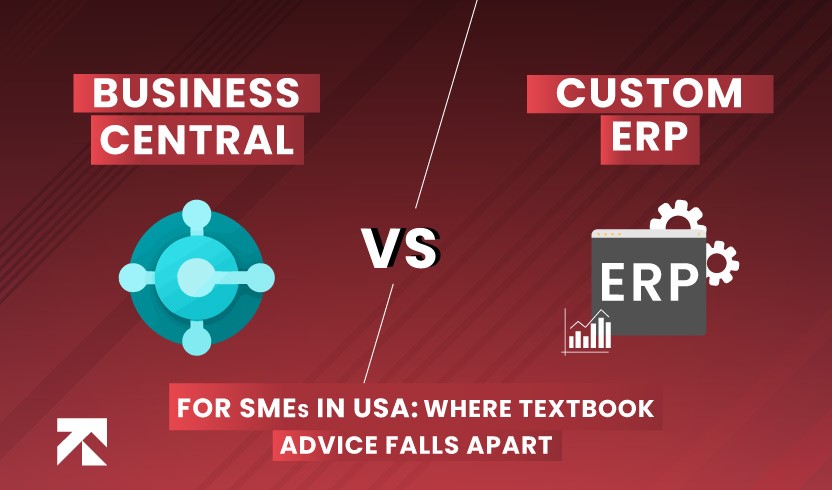
Businesses exploring ERP solutions are initially skeptical about choosing a solution and believe they need to customize it to meet their needs. But it isn’t always a viable option for success. Even after spending millions on these customized solutions, they don’t achieve results and experience stalled growth.
Whereas Business Central is a powerful solution that offers APP Source extensions that cater to all your needs. Any change in processes is not a big deal for the system, as there is already an extension built for it in App Source and Power Automate. Moreover, the services of a Microsoft Dynamics 365 ERP Consulting Partner actually make a difference.
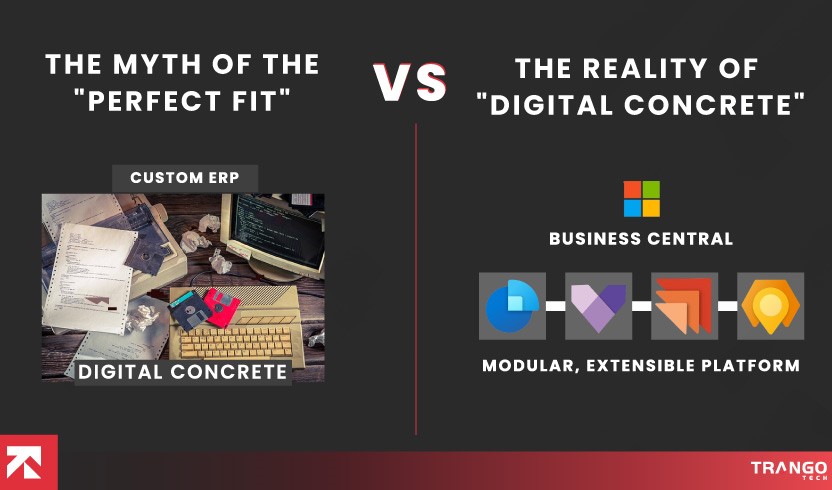
Well, there is a myth that you can build customized solutions to get what you want. But the reality is that your system does not stay stagnant; it grows and processes change over time.
Creating a customized solution means hiring a developer and going through the testing process. Developing such a system will make it difficult for you tomorrow, as you will require as much attention.
Digital concrete is introduced as a system suited to today, not to tomorrow. From tomorrow it means years to come.
The system’s extension-based architecture does not affect the core code. Now you can customize the system with extensions and update it without disruption. Dynamics 365 Business Central Customization does not break or fall apart.
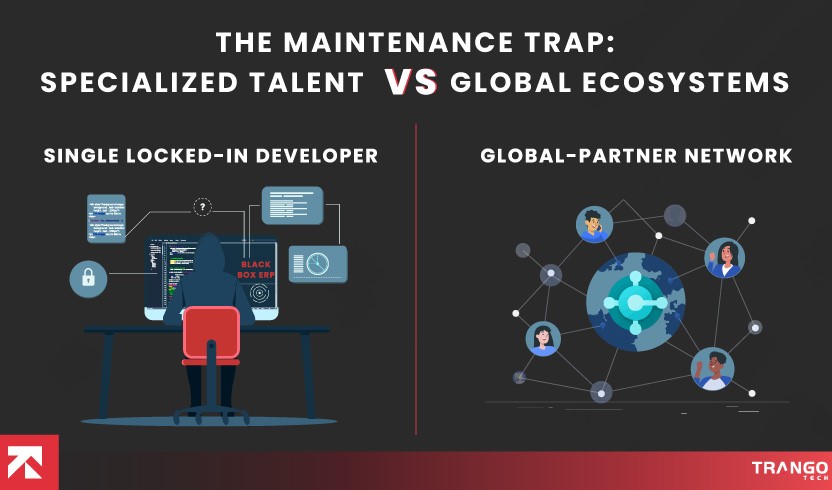
The perception of saving monthly licensing fees while owning the custom code.
The reality check is that the amount you pay goes to those developers who know the system.
And if the developer quits, the system is just another black box.
That is not the case with Business Central. Microsoft is a global name, with thousands of partners worldwide. If your current partner does not offer satisfactory results, you can choose another Partner. There is actual talent liquidity in Business Central.
The line ” Build whatever you need” is the most vague. Well, acquiring a large language model is not everyone’s cup of tea. It requires a lot of investment.
Predictive analysis is the talk of the town and the need of the hour for operating in the modern business world. And getting it in a custom ERP is highly expensive.
In contrast, Microsoft Copilot for Business Central provides generative AI capabilities within the standard workflow. All of this comes in the standard features, where you can automate bank reconciliations or draft product descriptions.
APIs are the source of communication.
Well, that’s another lie because they break.
The custom solution breaks whenever there is an API update. Using Business Central means you are under the Microsoft stack umbrella. Everything is connected with expert D365 BC migration services, including your email, spreadsheet, and Outlook, which can also be leveraged to communicate with a customer.
Ownership is much more worthy of data, not of code. Custom ERP is not for the long run, but Business Central is.
Custom ERP saves a lot of money.
Again, it’s a balanced lie because the hidden cost can overwhelm you in the future.
You need to handle upgrades, security, and related matters. It is now a technical debt that you need to repay.
If you choose a custom ERP, you handle security.
As you know, cybersecurity is not an optional thing this year.
Microsoft has a huge investment in the security of its system. But in a custom ERP, you need to maintain security, which will cost you a lot and bother you a lot.
Tackle everything, including authentication and data breaches. As a new business, you don’t need to worry about security, as Business Central has a robust security system that saves you from vulnerabilities.
In case of any breakage, you have to ask the developer to fix it.
And for every fixation, you need to pay. However, Business Central offers automatic updates that do not cost you
Custom ERPs are fewer in number, as you only get a single developer and a small software house.
But Business Central has many partners, and there is no shortage of talent as its skilled experts are in huge numbers.
Standardization does not mean you cannot innovate.
The system is actually used for performing your routine tasks. And these tasks do not need innovation to carry a competitive advantage.
If we talk about real advantages, they lie in the pricing strategy and market knowledge. This is why you need to optimize your standardized processes.
Business Central uses a best-practices framework to make your business audit-ready, investor-ready, and scalable, with robust audit trails and consistent data models.
You May Also Like: How I Turned a Failing ERP Project Around with a New Dynamics 365 Strategy
Let’s decode the flaw of the textbook advice regarding ERP. And the foremost thing you hear is that business processes are stable when actually they are not.
SME are operating in the technology-driven world and moving at a very fast pace. This is why they go through.
So the whole point of adopting an ERP system in the modern world is to keep up with the pace of change. A system that could acquire and apply new features, processes, and modules.
It replaces now with tomorrow. You need a system that adapts to business processes and is suitable for, or later required by, the business.
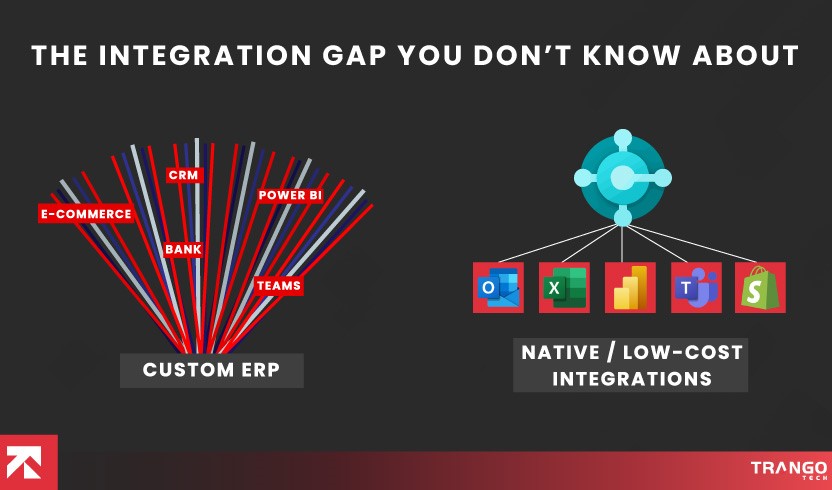
So the textbook says that custom ERPs can integrate with any system.
Well, that is true, but there is another reality related to it. Which means that you need to spend a lot on each integration the business acquires.
Yes, that is the hidden cost of the integration that businesses feel happy about.
Integration is an important aspect of a system, and no business can go without using it. Connecting to banking systems, ecommerce platforms, CRM systems, BI, and analytics tools is a must.
Dynamics Business Central provides native integration with these tools through Power BI dashboards, sales orders from Business Central and communication and collaboration via Teams.
Whereas it is not the case in custom ERP, where integrations are treated as distinct development projects. And those projects then require maintenance and lead to failure as well.
Modern ERP projects rely on AI to deliver the fastest, most data-driven solutions. Tools like Microsoft Copilot and AI agents offer well-defined business objects, standard data relationships, and schemas.
Custom ERPs do not use standard APIs or ready-made data models, leading to inaccuracies and slow-paced work.
Risks are inevitable and cannot be avoided at any stage. As the system grows, more stringent governance is needed.
An increase in the number of customers, vendors, and features leads to errors and compliance failures. These issues are not even visible until a system breakdown occurs.
Custom ERPs lack focus on control as the solution misses governance features. The solution is embedded manually, which creates chaos. The system lacks approval and workflow processes, leading to blind spots.
In contrast, Business Central already has all the controls built into the design. Role-based access, permissions, and workflows are set.
Business Central takes governance, risk, and compliance seriously as they promote reliability and security.
Along with audit trails. There is robust financial control that prevents the system from vulnerabilities such as fraud and costly errors. This is to build the credibility of businesses as they deal with various entities, such as banks and regulators.
Also Read: Business Central Vs Finance and Operations
Custom ERP makes sense when a business has unique workflows that other solutions do not offer. The ideal situation would be when there are no stringent compliance requirements. Enterprise owns the system with dedicated developers at its service, helping it survive and evolve.
In reality, many businesses are surviving in a competitive landscape and cannot really afford in-house engineering teams. And that does not make Custom ERP a viable long-term solution.
Rigidity cannot win. This is why extensible ERPs are surviving the purpose of ERP implementation, with safe customization and scalability. It is a stable system offering custom workflows, security, and safe integrations.
Standard functions do not require redevelopment because the ecosystem supports growth without change. It is a long-term solution ready for the future, and Business Central support services ensure seamless business operations at all times.
Custom ERP systems are fixed and incapable of handling growth. Enterprises acquiring these solutions are new to the field and lack sufficient technical knowledge, leaving them helpless when they struggle to survive. Custom ERPs are rigid, lack scalability, and require significant investment, which these businesses do not have.
Business Central’s built-in extensibility makes it a reliable solution. The standard workflow, compliance handling, and safe extensions and integration make it a scalable solution. It scales easily, and upgrades are very smooth, causing no disruption.
As the name suggests, a custom ERP is built for a business based on its specific requirements. It offers specific functionality to the business and offers seamless Dynamics 365 Amazon integration.
Business Central is a Microsoft Dynamics 365 ERP solution that offers standard workflows, secure integration, and updates, and meets industry needs. It is built to meet the needs of all SMBs.
Both are distinct: a custom ERP offers custom logic, often at high cost, whereas Business Central provides standard features and scales easily.
Custom ERP is risky to maintain, as over time, you need more functions that require more money, dedicated services, and compliance.
Business Central is a flexible solution that offers customization tailored to the business’s needs through safe extensions and integrations that do not break during updates. Moreover, the system is built to handle excessive load.
Yes. It is customizable, offering safe extensions.
Yes, hidden costs that businesses don’t realize initially include upgrades, integration costs, bug fixes, and developer costs.
The developer is the person with all the knowledge, as businesses are not aware of the system’s technicalities.
Absolutely, Business Central can easily connect with CRm, ecommerce, Power BI, and communication tools.
Integrations are expensive in custom ERPs because they require developers to write custom code.
Yes, it integrates Power BI for advanced reporting and analytics.
Compared to a custom ERP, Business Central is a safe solution because it offers security and scalability at an affordable cost.
Nowadays, businesses cannot afford to neglect AI, as they need a smart strategy to succeed. So an ERP solution must offer AI capabilities.
Trango Tech, a certified Microsoft Solutions Partner, transforms businesses by offering tailored ERP solutions that deliver a high return on investment (ROI).
Read MoreCalculate your complete Business Central implementation cost using our cost calculator.
Calculate now! Your Email Address Will not be published. Required Fields Are Marked
ERP project is the power word we have been hearing for so long. But its failure is what…
Business Central is a powerful solution designed to meet the needs of businesses. The real strength of the…
75% of ERP projects fail after implementation for several reasons. The reasons include poor data quality, inefficient business…
ERP project is the power word we have been hearing for so long. But its failure is what…
Business Central is a powerful solution designed to meet the needs of businesses. The real strength of the…
75% of ERP projects fail after implementation for several reasons. The reasons include poor data quality, inefficient business…
If you are confused and need expert advice to transform your business, our experts are available 24/7.
Don't waste a single second, as you will be left behind while others are already ahead, moving fast. Start Now!
Trusted by Clients Worldwide: Rated 4.9 Star